
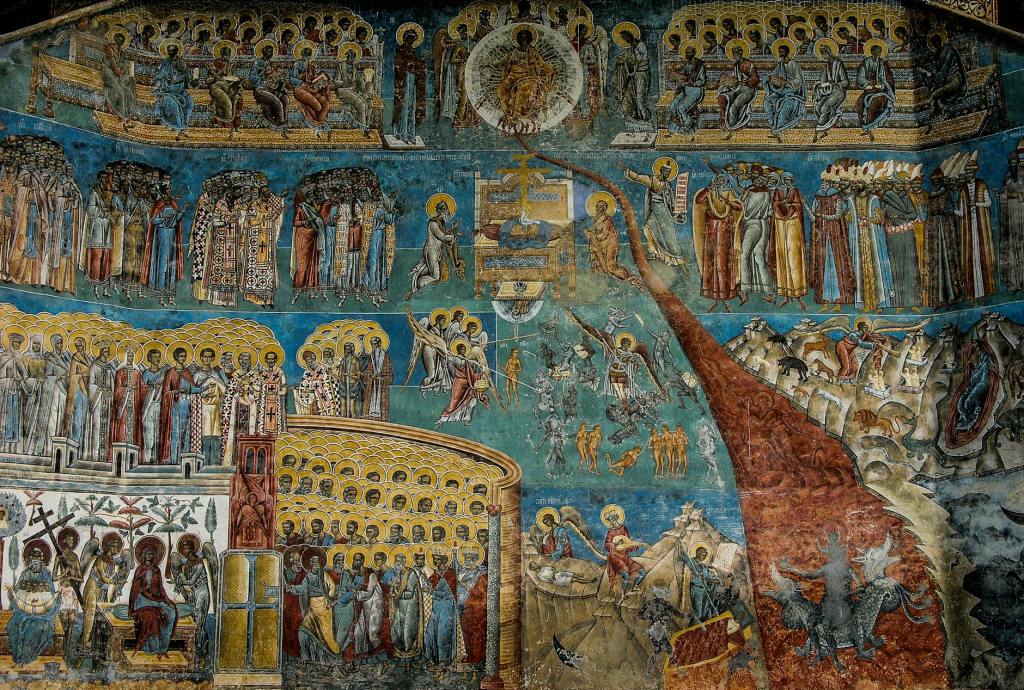
The painted monasteries of Bucovina, Romania, are considered the most important parts of our heritage in Romania. Most of them are more than 500 years old, they reflect the start of the consolidation of the culture in this area in terms of architecture and a lasting heritage. The painted churches of Romania are today UNESCO Heritage Sites.
If you are doing a short trip, doing a couple monasteries a day is a bit draining, so my pro tip for you is:
1.Visit Voronet Monastery for the famous blue colour, just know it is the most crowded and arguably the most beautiful.
2.The second most popular is Humor Monastery, which I personally recommend going to for mass, especially on Easter.
3.To visit, a bit more of a hidden gem, there is Moldovita Monastery, a bit smaller, a bit more cozy but not as crowded as the ones that are closer to larger towns
4.This one is a resurrected ruin, Arbore Monastery had a really rough time through its history, and this is why it’s one of my hidden gems in terms of story, personality, and importance.
5. Patrauti Church: If you are into legends, not sure how true they are, but it is fun, the church was designed to follow the sun for different messages and meanings, the legend of Ottomans freezing while trying to steal iconography from the church, and nuns surviving being locked in for long periods of time. But this requires a good guide for a really immersive experience.
Least favorite: Putna Monastery, the paintings are new, it is one of the most famous, and it’s too busy for a touristic purpose, can’t really say for a religious one.
Other suggestions based on this Instagram post:
Those are all my suggestions, now here is some information about all of the painted monasteries of Bucovina:
Voronet Monastery (1488)
Made by the most important ruler of the 15th century in the Romanian territories (Moldavia), it is a great example of Orthodox paintings and located in a picturesque location surrounded by forests. The church is painted in a Voronet Blue color, showcasing one of the most impressive depictions of judgement day out of any Orthodox Church. Described by Romanians as the Sistine Chapel of Eastern Europe.
Humor Monastery (1530)
The visual magic of Humor is largely owed to “Toma the Painter,” a master artist who signed his work in 1535. While Voroneț is famous for its blue, Humor is renowned for its “festive orchestration of warm colors,” specifically a reddish-brown hue that glows in the sunlight. These are the oldest open-air frescoes in Bucovina, and thanks to Toma’s skill, the vibrant scenes of the Last Judgment and the Hymn to the Virgin have survived nearly 500 years of weathering.
Sucevita Monastery (1586)
Sucevița Monastery, a fortified masterpiece of medieval Romanian art and spirituality, stands out through its unique emerald-green frescoes that vividly tell a complex biblical story through images, making it a cultural and religious symbol of Bucovina.
Moldovita Monastery (1532)
Moldovița Monastery was built in 1532 by Prince Petru Rareș after the original monastery collapsed due to landslides. The monastery was an important cultural center, where beautifully decorated religious manuscripts were copied as early as the 15th century. Its exterior frescoes are the best preserved among the painted monasteries of Bucovina, with vivid scenes, military saints on horseback, and 105 painted angels under the eaves.
Putna Monastery (1466)
The legend says that after a massive battle at Baia defeating the Tatar population, our most famous ruler, Stephen the Great, had a dream about building this monastery. The painting, unfortunately, is not an original one. How can you tell? Well, we switched from Romanian Cyrillic to the Latin alphabet in 1859.
Dragomirna Monastery (1609)
Dragomirna’s main church, completed in 1609, is one of the most unusually proportioned religious buildings in the Orthodox world — standing over 40 meters tall yet remarkably narrow, giving it the striking appearance of a ship, an ancient symbol of the Christian Church.
Arbore Monastery (1502)
Defaced by Ottoman incursions and mismanaged by the Austro-Hungarian Empire, this church faced significant damage, but it is still standing to this day. Not the most beautiful of the monasteries, but it is a very special one, a true survivor.
Patrauti Church (1487)
Technically it started off as a monastery, but today it no longer has this status, my favorite part about this place is the fact that it follows the sun in multiple ways. Open the door on Easter day and the sun shines in on the altar, well this is how it was planned initially as Easter varies from year to year
Probota Monastery (1530)
Probota was the first monastery in the Bucovina region to feature exterior frescoes. The church also features several Gothic-style details, including the entrance of the porch and the windows in the pronaos — an unusual blend of Gothic and Byzantine styles. Recent scientific studies revealed that the famous “Voronet blue” color was actually first used on the exterior of Probota’s church, predating its iconic use at Voronet Monastery.
Suceava Monastery (1522)
Also named Saint John the New. In 1686, the Polish army of King John III Sobieski looted the monastery and took its treasures, including the relics of Saint John the New. The relics were later transferred to a Basilian Monastery in Ukraine, and it was the Austrian Emperor Joseph II who eventually returned them to Suceava in 1783. Every year on June 24th, a huge pilgrimage takes place at the monastery, where thousands of believers gather for the Divine Liturgy and a procession with the holy relics.
 Dracula's Guide to Romania
Leave a comment