
I was thinking of adding palaces to the mix but to be honest… Why?!? Fortifications are amazing in their own right due to their positioning and famous battles experienced. With a ton of personal experience visiting the fortresses of Romania and with some inspiration from online sources, do I have a list for you! Let us begin!
Enisala – The Fortress of the Sea
A small medieval fortress close to the Black Sea, worth renting a car, experiencing the rolling hills of Dobrogea, and getting one of the best views in Romania. It was a fortress built by the Byzantines and used by Genoa, Walachia, and the Ottomans. Personally, my favorite fortress in Romania, not because of it’s grandeur (as it is rather small) but as an experience. You drive around rolling hills, you experience outstanding views, you have the view of a giant lagoon and wonder where the Black Sea starts, and you have Roman and Greek ancient fortifications and cities nearby. It is the type of place where you can daydream about history and imagine how things were, and this, my friends, is what makes traveling fun for me!
Poenari Fortress – Where the “real” Dracula hid
Everybody thinks of Bran Castle when they think of Dracula (or more precicesly, Vlad the Imapler) but Poenari fortress is the real deal. This is the place where Vlad the Impaler conducted his raids against the ottomans, this is the place where battle plans were hatched while in hiding, and this is the place that was born from the blod sweat and tears of city dwellers that defied the rule of Vlad. This fortress is located in a forest on the way to Vidraru Dam and takes you to Sibiu on the famous mountain road, The Transfăgărășan, a road through the highest mountains of Romania built during communism with great financial and human sacrifices. Still not the best-kept building as a whole but a lot of history and many places to visit in the surrounding area.
Alba Iulia – Star shaped bastion
The crown jewel of fortresses in Romania and the place where basically our declaration of independence was signed. This fortress was built under the Habsbourgs to protect the empire against the Ottomans. The Vauban-style bastion fortress in Alba Iulia was built between 1715 and 1738 during the establishment of Habsburg rule in Transylvania. Over 20,000 Romanian serfs from across Transylvania were forced to perform free labor in two-week shifts. Italian workers and craftsmen handled masonry, while special sculptures for the gates and bastions were created by a Viennese team led by Johann König. The walls, made of stone and brick, were designed with slightly sloped surfaces to deflect cannonballs. The fortress stands on the site of the Roman Castrum of the XIII Gemina Legion (106 AD) and the Medieval Bălgrad Fortress (16th–17th centuries) both in essence destroyed to make space for this unique fortification.
Suceava Fortress – The Old Moldavian Capital Fortress
Growing up, I would read stories about Steven The Great (Stefan cel Mare) and how he defeated the Ottomans, these stories oversimplified how great he actually is because the more I read, the more I realise how less relevant his battles were and how relevant his diplomatic skills were. Suceava was the capital and this was the crown jewel of fortresses, Stefan being the person that made the most significant contributions to its fortification. This is the fortress that has never been conquered and if you are wondering why is it’s state so poor? Well, in the mid 16th century, the Ottomans forced us to destroy all our defences and hence what we have today.
Fagaras Fortress – The fortress turned prison
Was looking for an article about Fagaras Fortress and the first thing that shows up: “this fortress has never been conquered” and I said to myself… “another one?”. This has always been a strategic position, and evidence of wooden palisades comes from the mid-13th century, but the first historical written confirmation can be found from the mid-14th century. Saddest story is that it was used during communsim as a political prison which doesn’t require explanations.
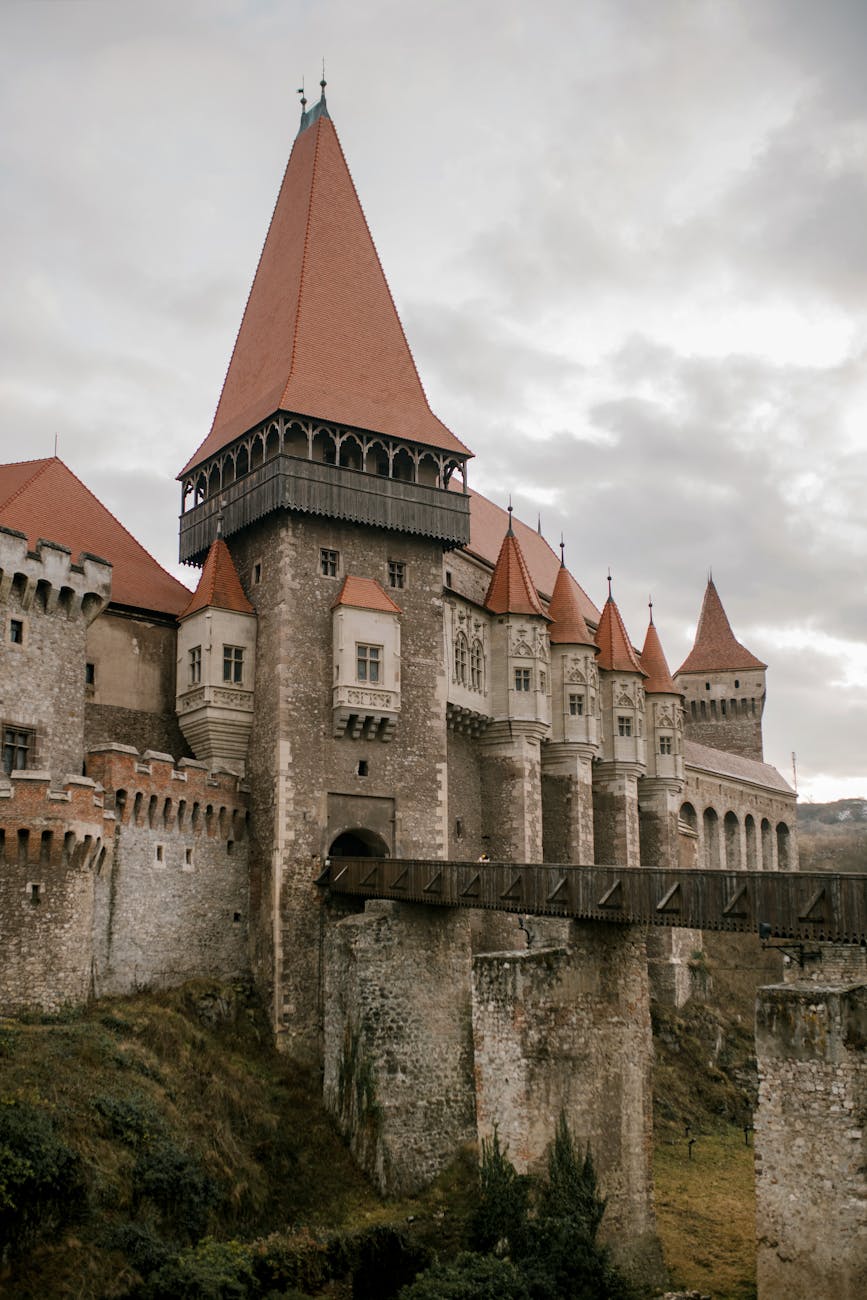
Huniazi/Corvini Castle – The Disneyland of Romanian Fortresses
The Hunyadi (Corvin) Castle in Hunedoara, Romania, is an impressive medieval fortress with beautiful architecture. Its large stone walls, tall towers, and wooden bridge make it look strong and majestic. Built in the 15th century, it played an important role in protecting the region from invasions. A famous legend says that Vlad the Impaler (Dracula) was once held prisoner in its dungeons. Inside, visitors can see grand halls, hidden passages, and old paintings that tell its history. The castle’s well-preserved design and mix of different architectural styles make it one of the most stunning castles in Europe.
Sarmiszegetusa – A sort of Stonehenge
Not much is left from this fortress but it is basically the Romanian version of Stonegenge that used to be sorounded by walls and the capital of the Dacians. Not much is known about the religion of the Dacians, a loose conglomeration of tribes that occupied the territory of what is modern-day Romania. During communist times, the restoration had some reinterpretations that are still present today.
Rașnov – The Shelter of the locals
Giovanni Andrea Gromo about the fortress: “A very strong fortress, built on the top of a rock, on a high and isolated mountain, which can only be reached by a path about three steps wide, winding along an exposed route.” The Râșnov Fortress was first mentioned in 1335 when it withstood a Tatar invasion, unlike most of the surrounding region. Built by local peasants using stone and brick, the fortress has a simple architectural style resembling regular houses, adapted for defense, it was a place of refuge. Last time the fortress was uesd was during the 1848-1849 revolution, the Râșnov Fortress served as a shelter for locals, who stored grain there. Its outer courtyard was used for training national guards.
Neamț Fortress – The big name stopper
The Neamț Citadel has a rich and fascinating history, marked by numerous battles and transformations. In 1476, it withstood a formidable siege led by Sultan Mehmed II . Later, in 1646, Vasile Lupu converted the citadel into a monastery, but it suffered partial destruction in 1675 under Dumitrașcu Cantacuzino. One of its most legendary moments occurred in 1691 when a small group of Moldavian soldiers heroically resisted an attack by the Polish army under King John Sobieski. However, in 1717, Prince Mihai Racoviță ordered its destruction, leading to the complete loss of its military significance. After centuries of decay, the citadel underwent extensive restoration between 2007 and 2009 using European funds, allowing visitors today to admire its historical halls, chapel, kitchen, mint, and dormitories.
Deva – Old Faithful military strategic point
This place has been used as a fortress for a long period of time, the fortress itself is dated from the 13th century but the usage of this former dormant volcano is more than 2000 years old, and there is even evidence from the Neolithic. You can visit this fascinating citadel and enjoy the views around by hiking or getting the lift up there. The legend has it that this place was built a stonemason and 12 other workers, but each day their work on the citadel would crumble. Believing a sacrifice was needed, they agreed to entomb the first wife, who brought them food. The main stonemason’s wife arrived first and was sacrificed, her ashes mixed into the plaster made the citadel remain standing. Fun fact: this story is common all across the Balkans.
Extra resources in Romanian (use chrome to translate):
Enisala fortress: https://historia.ro/sectiune/general/povestea-zidurilor-de-la-enisala-ultima-cetate-580624.html
Poenari Fortress: https://historia.ro/sectiune/travel/cetatea-poenari-577613.html
Alba Iulia fortress: https://historia.ro/sectiune/general/cetatea-bastionara-de-tip-vauban-alba-carolina-584170.html
Suceava Fortress: https://historia.ro/sectiune/general/cetatea-de-scaun-a-sucevei-fortificatia-care-nu-a-577531.html
Sarmizegetusa: https://historia.ro/sectiune/general/sarmizegetusa-regia-restaurata-fantezist-in-anii-2416442.html
https://historia.ro/sectiune/actualitate/cel-mai-vechi-drum-pavat-din-romania-construit-2404125.html
Rasnov: https://historia.ro/sectiune/travel/cetatea-rasnov-intre-legenda-si-istorie-foto-570107.html
Neamt: https://historia.ro/sectiune/general/cetatea-neamtului-587725.html
Website for some inspiration: https://aventurainromania.ro/top-20-de-cetati/
https://www.facebook.com/reel/1197246884661246

 Dracula's Guide to Romania
Leave a comment