
One of the best articles making suggestions in Bucharest is: https://www.nationalgeographic.com/travel/article/guide-to-bucharest-romania-underrated-capital
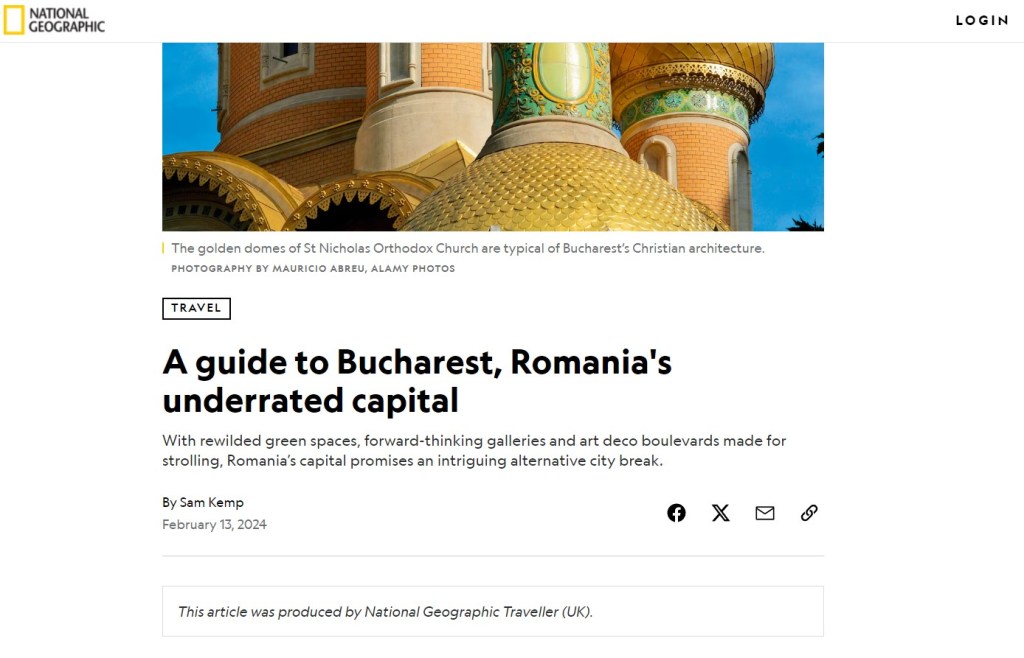
The first thing you’ll notice in the article is the photograph of Saint Nicholas Church, accompanied by the quote: “The golden domes of St Nicholas Orthodox Church are typical of Bucharest’s Christian architecture.” This statement is misleading. The church’s architecture is distinctly Russian Orthodox, more typical of what you’d find in Russia rather than Bucharest. If by “typical” they meant that Orthodoxy is the main religion in Bucharest and the city has a variety of architectural styles, then I can agree—but the specific claim about the domes being representative of Bucharest’s architecture is inaccurate.
Moving past that, the article begins by mentioning Primăverii Boulevard, highlighting landmarks such as the former dictator’s residence (Palatul Primăverii) and MaRe (the Museum of Recent Art). These are excellent recommendations, offering insight into the lifestyle of Romania’s communist elite who lived in what was then a luxurious area. The connection between this boulevard and Romania’s political history makes it a compelling first stop.
However, they link the Ceaușescu residence to Art Nouveau architecture, which seems to be a mistake. The mansion was built in the 1960s, and while I couldn’t find an official name for its architectural style, it certainly doesn’t reflect the Art Nouveau movement. Bucharest does have better examples of Art Nouveau elsewhere.
On a positive note, their mention of Patiseria Amzei is a gem. This historic pastry shop is always busy for a reason—it’s renowned for its exceptional “merdenele” pastries and long-standing tradition.
Casa Mita Biciclista, another landmark, is briefly mentioned but not explained. This house belonged to a high-end courtesan and has an interesting backstory, though I can see why the article chose not to delve into that aspect.
Kretzulescu Church is a fantastic recommendation. It’s an underrated gem located on the famous Victoriei Boulevard, a must-visit street in Bucharest. Nearby, the Artichoke Social House, a trendy off-the-beaten-path café, is another great find. A delightful detail included in the article is the mention of a theremin player occasionally performing in the area, adding a unique atmosphere with the eerie, sci-fi sounds of this rare instrument.
The article also highlights some of my personal favorites: Terasa Obor, perfect for experiencing Romanian street food right in the heart of Obor Market; Cărturești Carusel, a beautifully designed bookstore; and Soro Lume, one of the city’s finest high-end restaurants. These are all fantastic picks.
The highlight, though, is Văcărești Delta, an urban wetland that remains relatively undiscovered by many. Just two metro stops from the city center, this nature reserve is a tranquil escape where wildlife has reclaimed the land—a rarity in a bustling capital.
One suggestion that stood out to me was No Room Taproom. While I enjoy their beers, especially from Maktoob, the name is fitting—space is very limited, and I prefer a more comfortable setting when relaxing with a drink.
The article concludes with Cismigiu Park, Cotroceni (a charming and affluent neighborhood), and Therme, a massive spa that’s immensely popular. It’s fascinating how Therme has become a major attraction, drawing more attention on TikTok and Instagram than Dracula himself.

 Dracula's Guide to Romania
Leave a comment