

In 2016, the Salam de Sibiu (Sibiu Salami) was registered as a protected geographical indication (PGI) product in the European Union. To receive the PGI status, the entire product must be traditionally and at least partially manufactured (prepared, processed or produced) within the specific region and thus acquire unique properties.
Many Romanains are fond of this product due to it’s flavour but also historical atachment.
How did the story begin?
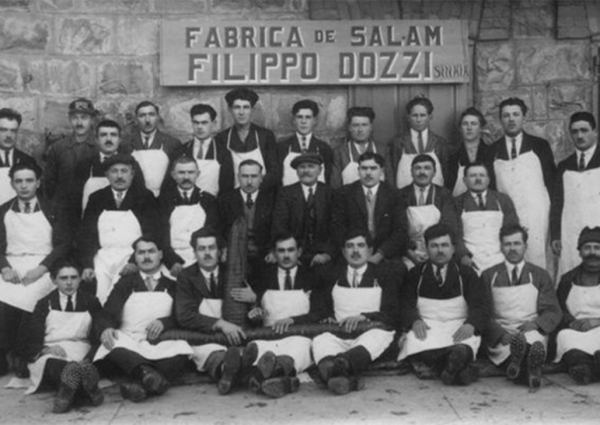
Salam de Sibiu has its origins in the 19th century when, around 1885, an Italian named Filippo Dozzi settled in Sinaia. His profession as a stonemason and talent for making salami led to the establishment of the “Filippo Dozzi Individual Enterprise” in 1910, where he began producing dry-cured salami. Due to favorable climatic conditions, the salami quickly became a luxury product, with production significantly increasing over the following decades.
After Dozzi’s death in 1943, the business was taken over by his sons, but in 1948 the factory was nationalized. During the communist regime, Salam de Sibiu remained a sought-after product, available only on the black market, most of the production going to export and the communist elite. Expansion and modernization of production occurred in the 1960s, reaching a capacity of over 2,000 tons annually.
In 2016, Romania obtained Protected Geographical Indication (PGI) status for Salam de Sibiu, emphasizing the strong connection between the product and its region of origin. Today, Salam de Sibiu remains a symbol of Romanian culinary tradition, continuing to be appreciated both domestically and internationally.
Sources used:
https://salamuldesibiu.ro/istoria-salamului-de-sibiu/
https://www.libertatea.ro/lifestyle/salamul-de-sibiu-istoric-reteta-4803683


 Dracula's Guide to Romania
Leave a comment